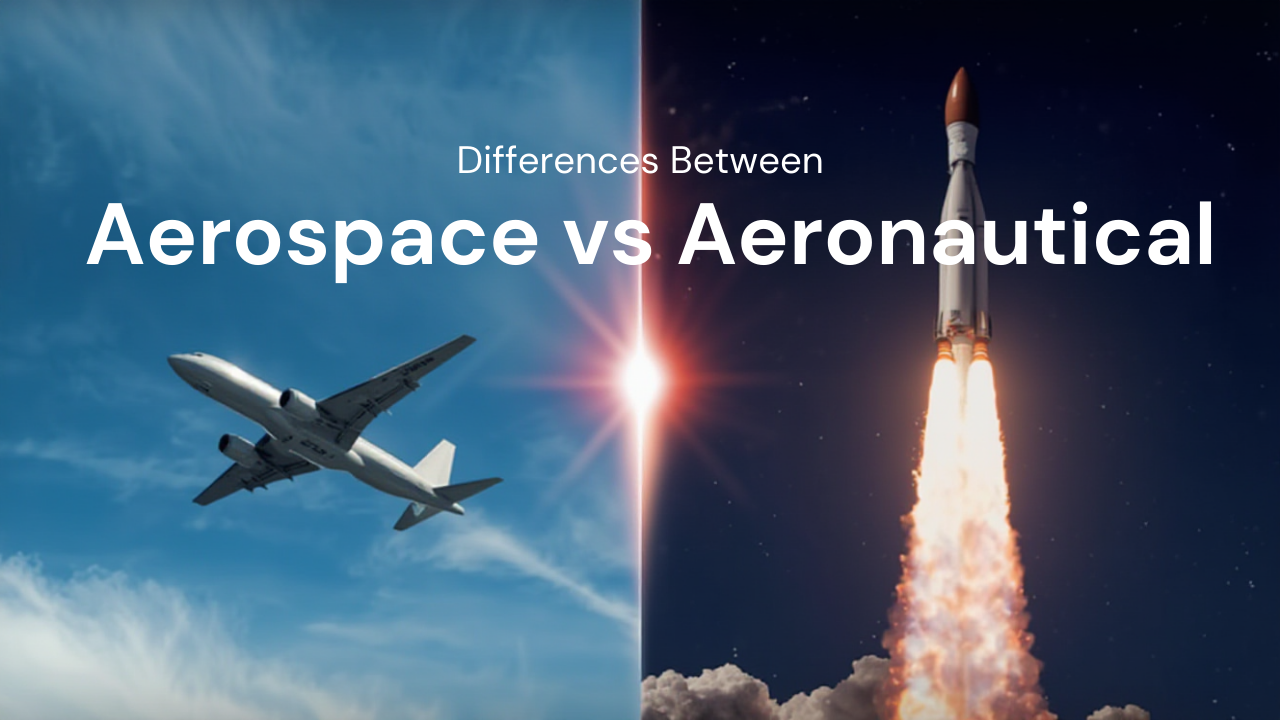
Differences Between Aerospace and Aeronautical Engineering Explained
- AME
- August 18, 2025
Engineering is a vast field that shapes the modern world. Among its many branches, aerospace and aeronautical engineering often attracts curious students who want to work with aircraft, spacecraft, or advanced flight systems. However, these two disciplines, though related, are not identical. Understanding their differences helps aspiring engineers choose the right path for their career.
This article explores the differences between aerospace and aeronautical engineering in detail. We will cover definitions, scope, study focus, industries, career opportunities, and required skills. By the end, you will have a clear picture of what sets them apart and which discipline might suit your interests.
What is Aerospace Engineering?
Aerospace engineering is a broad field that covers the design, development, testing, and maintenance of aircraft and spacecraft. It focuses on objects that move both within and beyond Earth’s atmosphere.
Aerospace engineering has two main branches:
- Aeronautical Engineering – Concerned with the study and development of aircraft that operate within Earth’s atmosphere.
- Astronautical Engineering – Focused on spacecraft, satellites, rockets, and systems that function in outer space.
Because it combines these two areas, aerospace engineering is considered a multidisciplinary field. It includes aspects of mechanical engineering, materials science, electronics, propulsion systems, thermodynamics, and advanced mathematics.
What is Aeronautical Engineering?
Aeronautical engineering is a specialized branch of aerospace engineering. It deals exclusively with the design, analysis, and performance of aircraft that operate in Earth’s atmosphere. This includes airplanes, helicopters, drones, and military fighter jets.
Aeronautical engineers focus on how aircraft interact with the atmosphere. Their work revolves around lift, drag, thrust, weight, stability, fuel efficiency, and safety. Unlike astronautical engineering, aeronautical engineering does not involve spacecraft or satellites.
In simpler words, while aerospace engineering looks at both the sky and space, aeronautical engineering looks primarily at air travel within the atmosphere.
Key Differences Between Aerospace and Aeronautical Engineering
Although both disciplines share common foundations, they differ in scope, curriculum, career opportunities, and focus areas. Below are the main distinctions explained in detail.
1. Scope of Study
- Aerospace Engineering: Covers both atmospheric flight and space exploration. It includes aircraft, rockets, satellites, space stations, and defense systems.
- Aeronautical Engineering: Limited to atmospheric flight. It studies airplanes, helicopters, UAVs, and related flight systems.
2. Industry Applications
- Aerospace Engineers work in aviation companies, space research centers, defense organizations, and satellite communication industries.
- Aeronautical Engineers mostly work in civil aviation, aircraft manufacturing, airline maintenance, and defense aviation.
3. Research and Development
- Aerospace Research includes advanced propulsion systems, space exploration vehicles, orbital mechanics, and extraterrestrial missions.
- Aeronautical Research is concentrated on flight safety, aerodynamics, fuel efficiency, and performance improvements of airplanes and helicopters.
4. Skills and Knowledge
- Aerospace Engineers must have expertise in rocket propulsion, orbital dynamics, astronautics, and space materials.
- Aeronautical Engineers need strong knowledge of aerodynamics, fluid mechanics, aircraft structures, and control systems.
5. Career Opportunities
- Aerospace engineers may work with space agencies like NASA, ISRO, or ESA, as well as companies like SpaceX, Boeing, and Lockheed Martin.
- Aeronautical engineers often join commercial airlines, aircraft manufacturers, and defense forces, focusing on atmospheric flight technologies.
6. Curriculum Differences
Both courses cover physics, mathematics, propulsion, aerodynamics, and control systems. But aerospace programs include additional modules on space systems, orbital mechanics, and rocket science. Aeronautical programs emphasize atmospheric aerodynamics and flight testing.
Subjects in Aerospace Engineering
Typical aerospace engineering programs include:
- Fluid Mechanics
- Thermodynamics
- Aerodynamics
- Aircraft Structures
- Space Dynamics
- Rocket Propulsion
- Orbital Mechanics
- Avionics Systems
- Computational Simulation
Subjects in Aeronautical Engineering
Aeronautical engineering courses focus more on atmospheric flight and include:
- Fluid Dynamics
- Flight Mechanics
- Aerodynamics
- Propulsion Systems
- Aircraft Maintenance
- Structural Analysis
- Flight Testing and Simulation
- Air Traffic Management
Industries Hiring Aerospace Engineers
Graduates in aerospace engineering find opportunities in industries such as:
- Space Agencies: NASA, ISRO, ESA, JAXA
- Defense and Military Organizations
- Aircraft and Spacecraft Manufacturing: Boeing, Airbus, Lockheed Martin, SpaceX
- Satellite Communication Companies
- Research Laboratories and Universities
Industries Hiring Aeronautical Engineers
Aeronautical engineers are in demand in sectors like:
- Civil Aviation: Airlines and aircraft maintenance companies
- Aircraft Manufacturing: Airbus, Boeing, HAL, Embraer
- Defense Aviation: Air Force, military aviation research centers
- Unmanned Aerial Vehicle (UAV) Development
- Government Agencies Regulating Air Safety
Career Roles in Aerospace Engineering
Typical job roles include:
- Aerospace Design Engineer
- Propulsion Engineer
- Satellite Engineer
- Spacecraft Systems Designer
- Flight Test Engineer
- Research Scientist in Space Technology
Career Roles in Aeronautical Engineering
Common career positions are:
- Aerodynamics Engineer
- Aircraft Design Engineer
- Flight Mechanics Specialist
- Maintenance Engineer
- Air Safety Engineer
- UAV Engineer
Required Skills
Both disciplines require strong foundations in mathematics, physics, problem-solving, and computational methods. However, there are some specific skill differences.
- Aerospace Engineers need:
- Knowledge of orbital mechanics
- Understanding of space environments
- Expertise in rocket propulsion
- Advanced simulation and modeling skills
- Aeronautical Engineers need:
- Mastery of aerodynamics
- Aircraft maintenance knowledge
- Practical flight testing skills
- Awareness of aviation safety standards
Which is Better: Aerospace or Aeronautical Engineering?
The choice depends on your career goals. If you are fascinated by space exploration, satellites, and rockets, aerospace engineering is the right choice. If you are more interested in airplanes, helicopters, and drones, then aeronautical engineering is the better path.
It also depends on industry demand. With the rise of commercial space programs, aerospace engineers are highly valued. However, with the rapid growth of global air travel, aeronautical engineers continue to be in strong demand.
Future Scope
The future of both fields is promising. Aerospace engineering is expanding due to increasing interest in space missions, satellite launches, and interplanetary research. Private companies are pushing innovation at a fast pace.
Aeronautical engineering is equally important. Civil aviation is growing worldwide, requiring continuous improvements in fuel efficiency, safety, and technology. UAVs and drones are creating new career opportunities in defense, logistics, and commercial sectors.
Salary Expectations
Salary depends on country, company, and experience level.
- Aerospace Engineers working in space research organizations often command higher salaries because of the specialized knowledge required.
- Aeronautical Engineers earn competitive salaries in airlines, aircraft manufacturing, and defense aviation.
On average, aerospace engineers tend to have slightly higher pay due to the inclusion of astronautical engineering, which requires advanced expertise.
Conclusion
Both aerospace and aeronautical engineering are challenging and rewarding fields. Aerospace engineering is broader, covering both atmospheric and space systems, while aeronautical engineering is more specialized, focusing on flight within Earth’s atmosphere.
Choosing between them depends on your passion, whether you want to work on aircraft flying through the skies or spacecraft exploring the universe. Both careers promise innovation, global opportunities, and exciting challenges.
If you are planning to pursue a career in aerospace or aeronautical engineering, selecting the right college is crucial. AME College helps students choose the best colleges tailored to their interests and career goals. With expert guidance and updated resources, AME College ensures that students take the right step toward a successful engineering journey.
Recent Posts























































Share This News